MENU
MENU
A group of young scientists from Giessen—from Justus Liebig University Giessen and the Technical University of Central Hesse—is currently setting up an experiment that will be flown on a stratospheric balloon as part of the BEXUS-38 mission. The project name: CLOUDS (»Calcium carbonate Light Observation Under stratospheric Dynamics and Scattering«).
Objective: To measure how calcium carbonate particles (CaCO₃) spectrally alter the spectrum of incident sunlight—and to analyze what this reveals about scattering effects. A dual microspectrometer from Eureca is planned as the central measuring instrument.
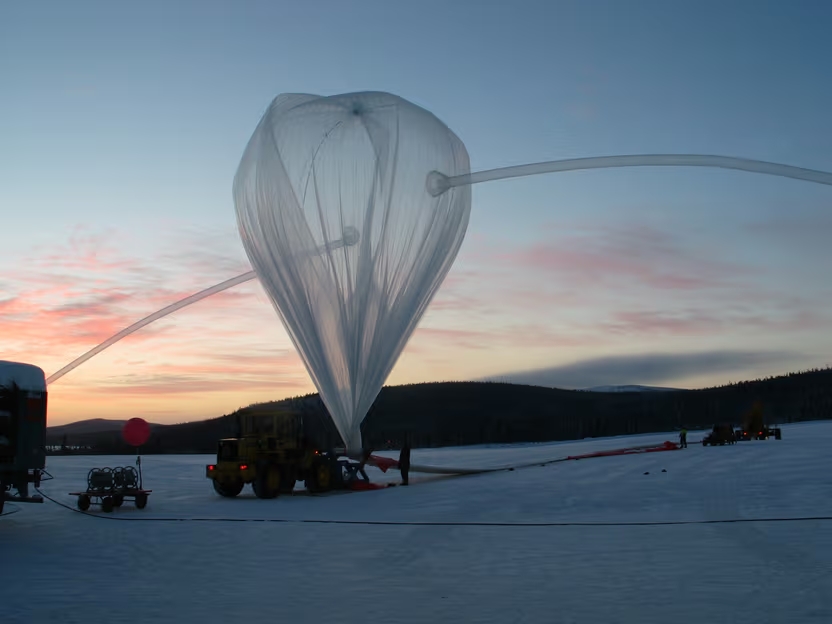
Esrange Launch Site: A stratospheric balloon ready for launch—the platform for BEXUS experiments. (©CLOUDS-Team)
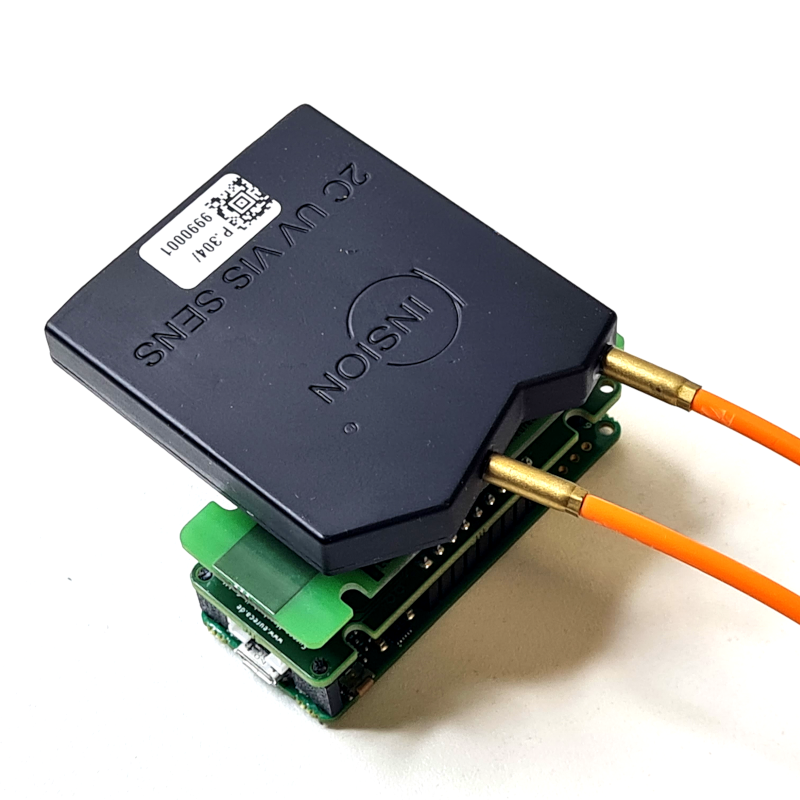
e9u-SPMD-350/850-10-Duo dual microspectrometer (350 – 850 nm): Two optical paths for measurement and reference. (©EURECA)
The CLOUDS team is currently in the »system fine-tuning« phase: the visual design, reference concept (dual-path), and testing strategy are being finalized. On this page, we’ll document our journey to launch with regular updates—including interim progress reports, integration updates, and lessons learned.
The group successfully completed the Integration Progress Review on June 16, 2026, and the spectrometer is now in operation during the testing phase.
The REXUS/BEXUS program is carried out under a bilateral agreement between the German Aerospace Center (DLR) and the Swedish National Space Agency (SNSA).
BEXUS stands for »Balloon Experiments for University Students«. Here, students have the opportunity to conduct their own scientific experiments using stratospheric balloons. The launch site is the Esrange Space Center in Kiruna. The launch campaign for BEXUS-38 is scheduled for October 2026, and the flight typically lasts about 2 to 5 hours.
»REXUS/BEXUS Student Experiment Programme«; Credit: DLR/SNSA
How does the presence of CaCO₃ particles alter the incident solar spectrum under stratospheric conditions—and what can be inferred from this about the scattering properties of these particles?
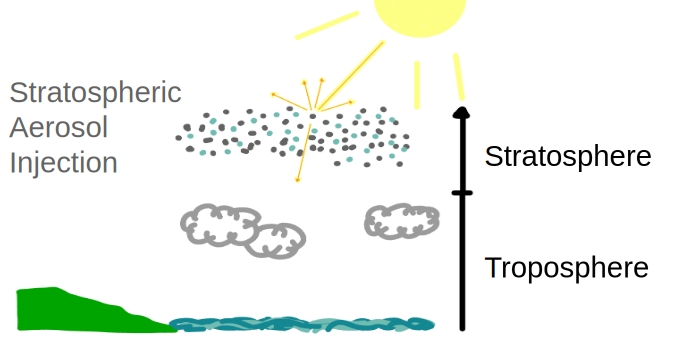
Conceptual diagram: SRM reflects a portion of the sun's radiation via aerosols in the stratosphere – CLOUDS measures the spectral effects. (©CLOUDS-Team)
The Earth’s climate depends heavily on how much sunlight the atmosphere scatters back into space and how much radiation ultimately reaches the ground. Aerosols in the stratosphere can influence this radiation balance—but it is not just »how much« light is scattered or absorbed that matters, but also »at which wavelengths.« This is exactly where CLOUDS comes in: Spectral measurements reveal how calcium carbonate particles alter incoming sunlight and how strong the scattering is across different spectral ranges. Such data are crucial for improving physical models of particle-radiation interactions and for estimating effects more realistically. In addition, the experiment makes a practical contribution to atmospheric research because it demonstrates how spectroscopy can be robustly implemented as a measurement method under near-stratospheric conditions (low pressure, low temperatures, vibrations).
The team cites calcium carbonate (CaCO₃) for its high scattering efficiency, low absorption in the thermal infrared, favorable chemical properties, and potentially longer atmospheric lifetime, among other reasons. Furthermore, different wavelengths contribute differently to warming—and CaCO₃ can behave differently depending on the wavelength. This is precisely why spectral measurements are so fascinating: they show how light changes as it passes through the particles and how strong the scattering is.
The CLOUDS configuration includes a dual microspectrometer. The specified spectral range is 350 – 850 nm, with a spectral resolution of approximately 10 nm. The dual-path approach is more than just a »nice-to-have«: A reference path can help control typical sources of interference that occur in complex setups (coupling fluctuations, drift, aging/contamination of optical components). This is an enormous advantage, especially in an experiment that must run reliably as a complete system.
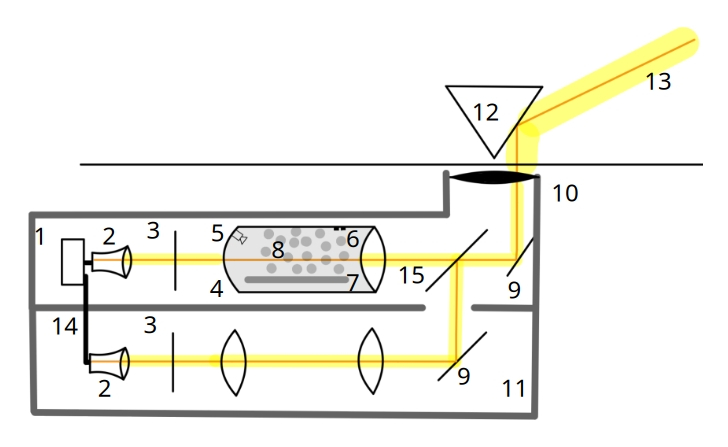
Block diagram of the experiment: chamber containing CaCO₃ aerosol, sensor array, and light-tight optics leading to the dual microspectrometer (350 – 850 nm).
This page is updated regularly. If you’d like to follow our progress, you can check the updates here on the website—and keep up with selected milestones on our social media channels as well.


Here you can easily ask a question or inquiry about our products:
Last update: 2026-06-09

EURECA Messtechnik GmbH
Deutz-Kalker Straße 35, D-50679 Köln
Phone: +49 (0)221 952629-0
Fax: +49 (0)221 952629-9
info(at)eureca.de
www.eureca.de