MENU
MENU
Some experiments don't start with a neatly labeled test tube, but with a small green speck of light on a summer night.
For this application example, the light emitted by a firefly was analyzed spectroscopically. To do this, the optical fiber of a microspectrometer was carefully positioned as close as possible to the glowing abdomen of the insect. The measurement took only a short time; afterward, the firefly was released back into the wild—still glowing and apparently unfazed by its brief stint as a research subject.
The result is a striking example of natural bioluminescence: a broad emission band in the yellow-green spectral range—precisely where we can see the glow with the naked eye.
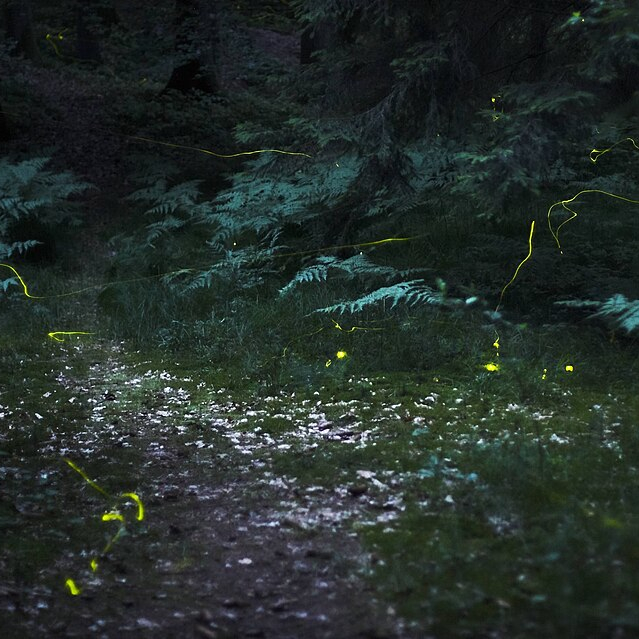
Swarms of fireflies in the forest: Their glowing trails become visible thanks to a long exposure. Detail from a photo by Quit007 / Wikimedia Commons, CC BY-SA 3.0, cropped.
Fireflies are a wonderful example of how spectroscopically fascinating light sources don't necessarily have to come from a laboratory. If you're out and about in the evening in June or July in a dark meadow, at the edge of a forest, or in a natural garden, with a little luck you might spot tiny yellow-green points of light. It looks almost like something out of a fairy tale—but it's actually hard-core biochemistry with a very pretty visual effect.
It is precisely this contrast that makes this experiment so fascinating: The eye perceives a faint »glow«, while the spectrometer reveals a measurable spectral distribution. A moment in nature becomes a quantitative experiment.
Throughout this page we use the familiar term »firefly« for these bioluminescent beetles. The name is easy to understand internationally, even though it is not quite precise: fireflies are not flies, but beetles belonging to the family Lampyridae.
For the European species Lampyris noctiluca, the more specific English name is »common glow-worm«. This name fits the appearance of the flightless female particularly well: with its elongated, segmented body, it looks much more like a larva-like »glow-worm« than like the typical winged beetle many people have in mind.
The German traditional name »Johanniswürmchen« refers to St John's Day on 24th June. Around this date, fireflies and glow-worms are often especially easy to observe. This is not a calendar trick, but simply the mating season of many species.
If you want to try this experiment yourself, you'll need, above all, patience, darkness, and a little bit of summer luck. The best chances are typically on warm, calm evenings from mid-June to early August. Fireflies are observed particularly frequently from dusk until around midnight.
Suitable locations are natural, relatively damp habitats: forest edges, meadows, thickets, gardens, and parks with little artificial lighting, as well as areas near ponds, streams, or riverbanks. Direct street lighting, bright flashlights, and closely mowed, featureless areas, on the other hand, tend to deter fireflies rather than attract them.
Practical tip: Let your eyes adjust to the darkness first, then start looking around slowly. Often, you'll spot the animals not by frantically shining a light around, but by standing still for a few minutes and observing the dark edges of the grass, bushes, and the sides of the path.
In fireflies, the division of roles varies depending on the species. In the case of the common glow-worm (Lampyris noctiluca), for example, the males are winged and actively fly in search of females. The females, on the other hand, are wingless; they sit on the ground or climb slightly higher up on blades of grass and plant stems. There, they project their yellow-green light upward so that it is as visible as possible.
It's important to note this small biological caveat: Not every flying light is automatically a male common glow-worm. In the case of the Small Firefly (Lamprohiza splendidula), the males can also fly and glow brightly. In the Short-winged Firefly (Phosphaenus hemipterus), on the other hand, both sexes are flightless; these insects emit only a faint glow—or one triggered by disturbance—and mate finding likely occurs primarily through pheromones. For observers, however, the simple rule of thumb remains useful: stationary, brightly glowing insects without visible wings are often adult females; flying points of light are often males searching for females.
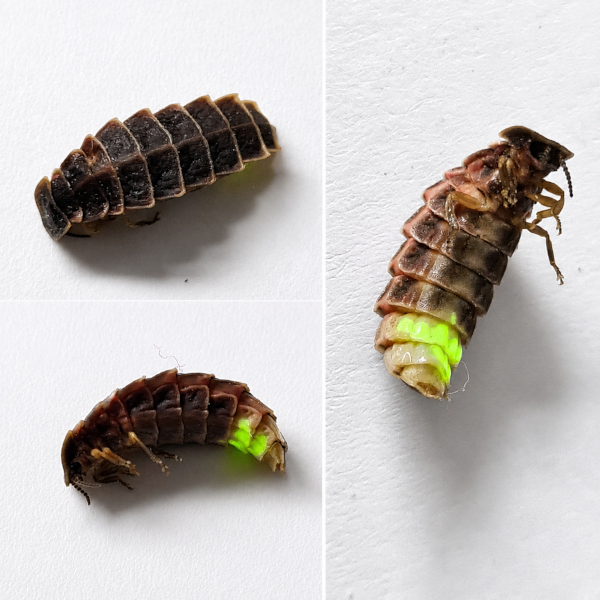
A glowing firefly during the brief, animal-friendly examination.
The insect used for this measurement was found on the ground; it was elongated, segmented, lacked visible wing covers, and had a distinctly luminous abdomen. Its brownish coloration and conspicuous light-producing organ suggest that it is very likely a female of the common glow-worm.
Capturing an insect for measurement should be like a careful rescue operation—not a beetle hunt! So: first look for it, then marvel at it, and then handle it very gently.
For the measurement shown here, the beetle was carefully picked up from the ground, quickly taken to the lab, and examined there only briefly. The light guide was held as close as possible to the glowing abdomen without squeezing the beetle or touching it unnecessarily. After the measurement, it was taken straight back to where it was found. There, the firefly was released again—and continued to glow, seemingly unfazed by its little outing.
For anyone wishing to repeat this experiment:
The setup was deliberately kept simple: a microspectrometer, a light guide, a dark environment, and a very cooperative firefly. The light guide was positioned a short distance from the glowing abdomen so that the emitted light could be directly coupled into it. An additional excitation light source was not needed, because bioluminescence is not fluorescence: the animal produces the light itself through a chemical reaction.
In this setup, the intensity values in counts depend on several practical factors: the distance and angle of the optical fiber, the numerical aperture, the integration time, the dark background, the stability of the position, and, of course, the animal's actual luminescence behavior. The spectrum is therefore not a radiometrically calibrated absolute reference spectrum, but rather a clear, easily interpretable measurement of the coupled emission.
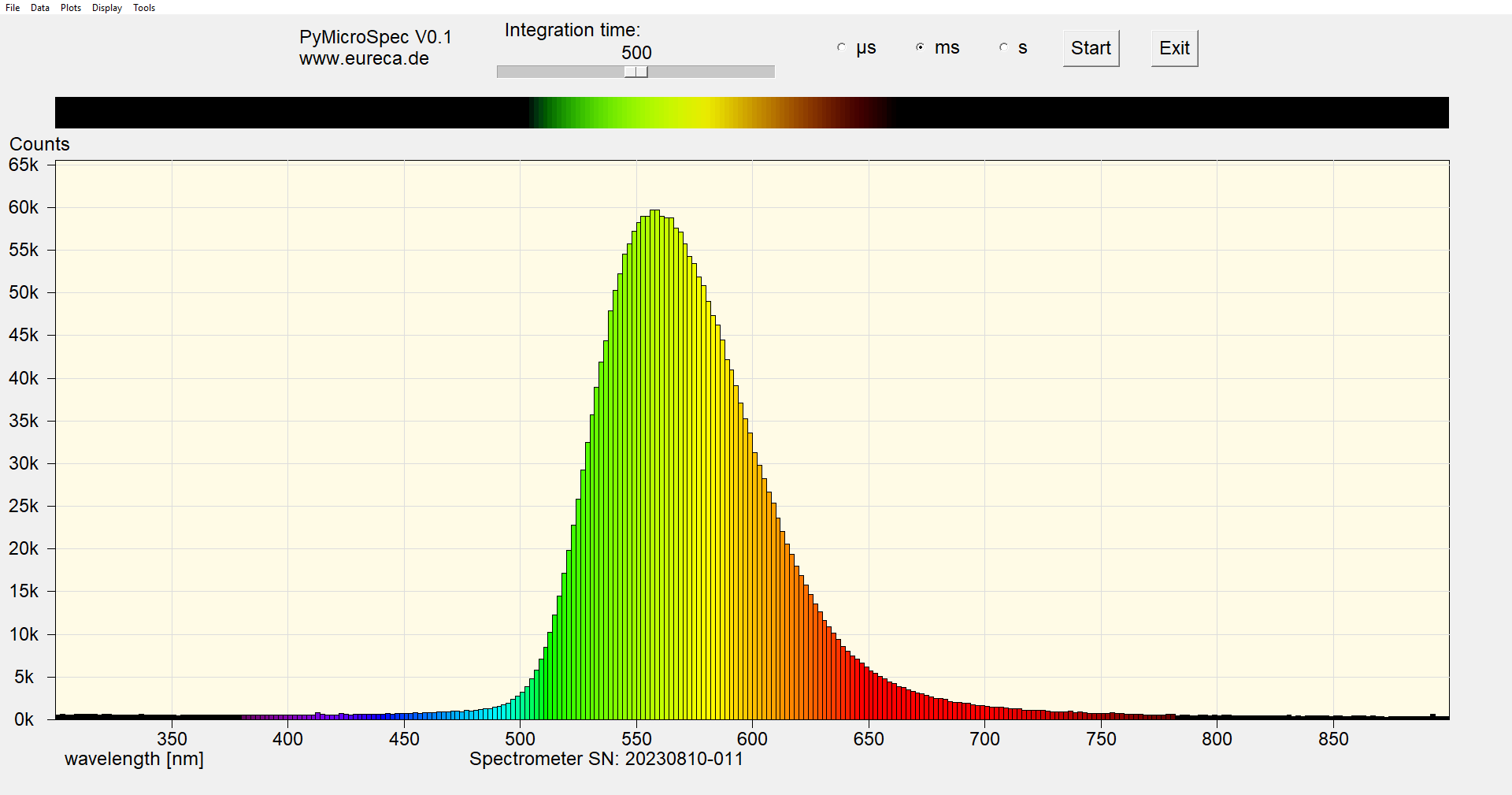
Spectrum recorded from the firefly. The broad emission band peaks in the yellow-green region at around 560 nm.
The spectrum does not show narrow lines, as in a gas-discharge lamp, but rather a broad emission band. The peak intensity lies in the yellow-green range, roughly between 550 and 570 nm. It is precisely there that the beetle's glow appears particularly bright to our eyes.
At shorter wavelengths, the intensity drops significantly toward the blue end of the spectrum. At longer wavelengths, the emission extends into the orange-red range with a flatter tail. This creates the typical color impression: not pure green, not quite yellow, but that characteristic »firefly green«, which stands out remarkably well from its surroundings at twilight.
From an educational standpoint, this is a nice comparison to technical light sources: A neon or mercury lamp produces narrow lines, an LED often produces an asymmetrical band with semiconductor characteristics, and the firefly exhibits a molecular emission band resulting from a biochemical reaction. Three light sources, three completely different spectral profiles.
The light is produced through bioluminescence, a process in which chemical energy is directly converted into light. In fireflies, luciferin, the enzyme luciferase, oxygen, and ATP—as a biological energy carrier—play key roles. Simply put, luciferin is converted into an excited reaction product in an enzyme-catalyzed reaction. When this product returns to its ground state, a photon is emitted.
The key point: very little heat is generated. That's why it's often referred to as »cold light«. For such a small animal, that's pretty ingenious. The light signal needs to be visible, but of course the beetle doesn't want to burn through energy like a mini light bulb in the process.
In (adult) fireflies, the light serves primarily as a means of finding a mate. Females make themselves visible, while males search for the signal. The color, brightness, duration, and spatial position of the light are therefore not just pretty—they're part of a communication system.
For us on land, fireflies are the most accessible examples of bioluminescence. But there are many other organisms around the world that produce light—especially in the ocean. There, bioluminescence is practically a standard evolutionary strategy.
This diversity is particularly fascinating for spectroscopy because not all bioluminescence works the same way chemically. Different luciferins, luciferases, photoproteins, or symbiotic systems can produce different colors, light-emitting profiles, and spectral shapes.
The experiment combines nature observation, biology, chemistry, and spectroscopy in a single snapshot. These are exactly the kinds of examples that quickly catch learners' attention: First, there's a tiny creature that glows at night. Then comes the question: »What color is this light really?« And just like that, you're right in the middle of exploring emission spectra, molecular orbitals, enzyme reactions, detector signals, and measurement geometry.
This provides a good starting point for various follow-up lesson topics:
Here, we are not measuring a laboratory lamp, but rather the natural, faint light emitted by a living animal using a compact microspectrometer and a simple optical fiber.
Using the Eureca microspectrometer, the natural light emitted by a firefly was successfully analyzed spectroscopically. The recorded spectrum shows a broad emission band with a maximum in the yellow-green region, which corresponds very well to the visible color appearance of the insect.
This application example charmingly demonstrates how accessible yet technically rich spectroscopy can be. An optical fiber, a compact spectrometer, a bit of a summer night … and a tiny point of light becomes a measurable natural phenomenon.
Or, to put it a little more poetically: Sometimes you just have to look into the darkness long enough until nature itself turns on the right light.
 Would you like to replicate the experiment—in your laboratory or teaching environment? Feel free to contact us—we will assist you with planning, setup, calibration, and selecting the right components. Eureca offers advice based on many years of expertise in optoelectronics, optics and spectroscopy—from DIY setups to OEM solutions. Feedback is expressly welcome: Please share your experiences, results, or suggestions for improvement with us.
Follow us—for example, on LinkedIn—to stay up to date on the latest developments!


Here you can easily ask a question or inquiry about our products:
Last update: 2026-07-10

EURECA Messtechnik GmbH
Deutz-Kalker Straße 35, D-50679 Köln
Phone: +49 (0)221 952629-0
Fax: +49 (0)221 952629-9
info(at)eureca.de
www.eureca.de