MENU
MENU
How can several optical signals be transmitted simultaneously and then separated again afterwards? This was the central question behind an experiment carried out in the QuantumLab (in German) at DHBW Stuttgart. In a setup designed, built and supervised by Mr Bernd Hänsch-Rosenberger, (in German) a wavelength-division multiplex signal was generated, transmitted and then optically demultiplexed.
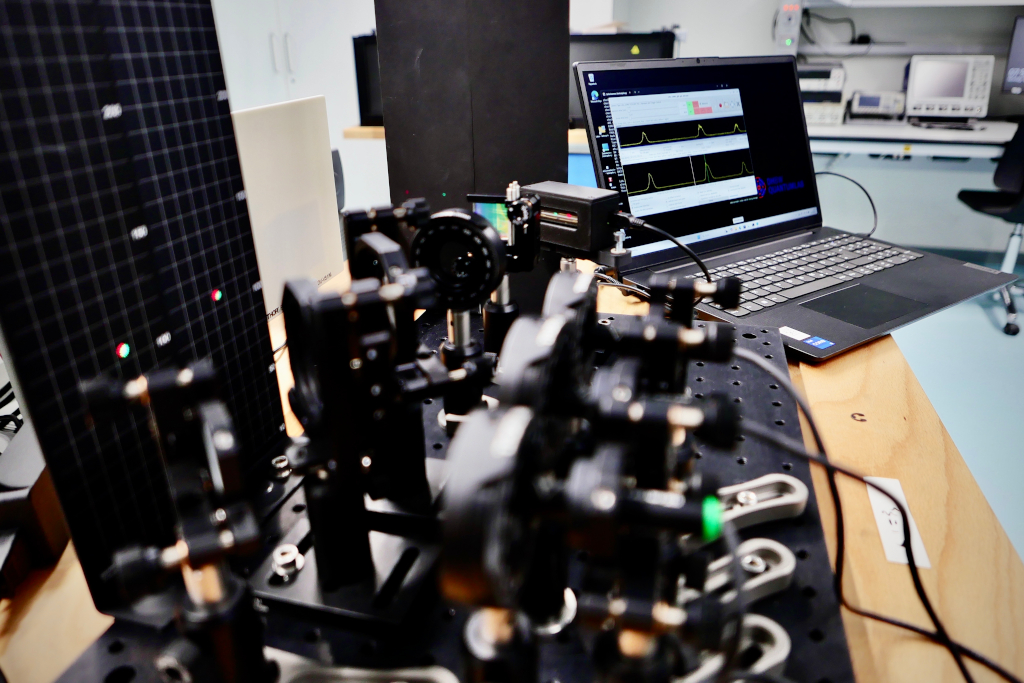
From an optical signal to a digital measurement curve: in the experimental setup, the spectrally separated channels become visible and are digitally captured using the line-scan camera. (© DHBW Quantumlab)
Several light signals with different wavelengths are transmitted together. After transmission, they are spectrally separated again using a diffraction grating. The individual wavelengths then appear at different positions. This is where the EDU version of our line-scan camera board comes into play: it converts the spatially separated optical signals into electrical and digital measurement data.
In this way, an optical multiplex signal becomes a directly evaluable digital signal. For students, this provides a very clear demonstration of how optical transmission, spectral separation, detection and digital signal processing interact.
The QuantumLab at DHBW Stuttgart is an interdisciplinary laboratory for modern quantum technologies. It is aimed in particular at students in technical degree programmes and follows a clear hands-on approach: concepts from quantum physics and photonics are not only discussed theoretically, but made tangible through experiments.
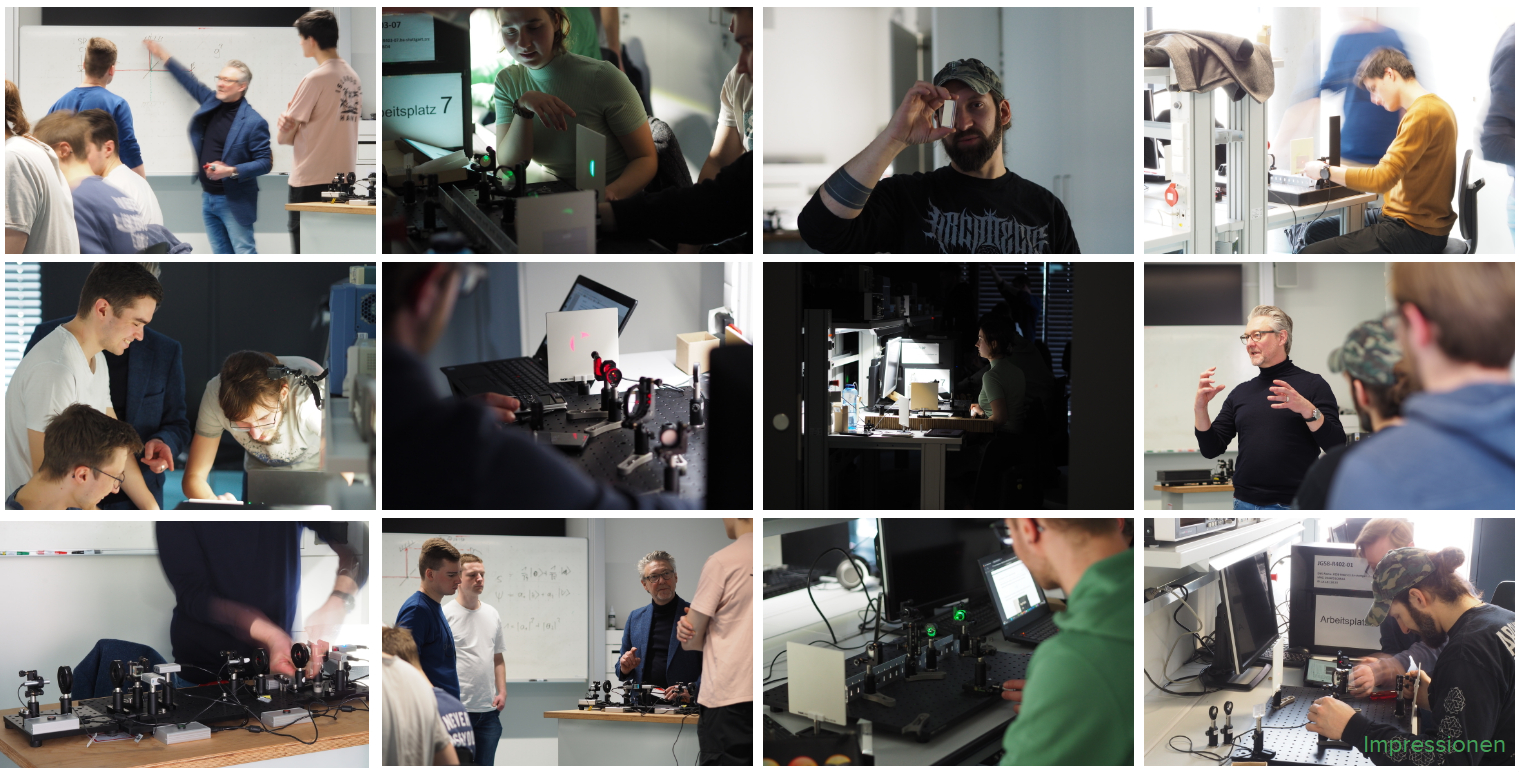
The QuantumLab at DHBW Stuttgart combines modern quantum and photonics experiments with practice-oriented teaching in technical degree programmes. (© DHBW Quantumlab)
Among other topics, the QuantumLab offers experiments on single photons, photonic qubits, polarization, interference, quantum information and quantum sensing. Its equipment and experimental concepts build a bridge between fundamental physics and engineering applications.
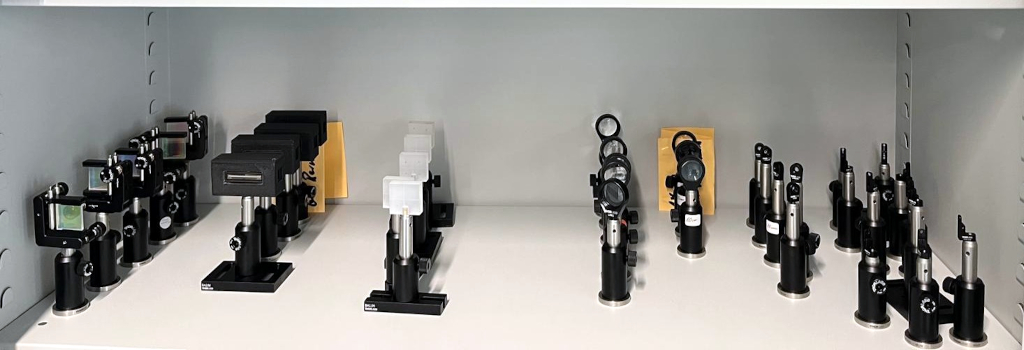
Optomechanical components and didactic setups provide the basis for flexible experiments in photonics and quantum technology. (© DHBW QuantumLab)
Facilities like this were exactly what we had in mind when developing our EDU line-scan camera boards: teaching laboratories, practical courses and student projects where robust, easy-to-understand and easily integrable sensor technology is needed. Students should not merely operate a ready-made instrument; they should be able to follow the entire signal path — from light to sensor to digital evaluation.
In wavelength-division multiplexing, several pieces of information are transmitted simultaneously using different wavelengths. The principle is well known from optical communication technology: instead of using a separate transmission channel for each signal, different spectral channels are combined and transmitted along a shared optical path.
In the experiment, such a multiplex signal is generated and then separated back into its spectral components. To do this, the light is directed onto a diffraction grating. The grating deflects the different wavelengths at different angles. As a result, the originally combined light beam becomes a spatial distribution: each wavelength reaches the detector at a different position.
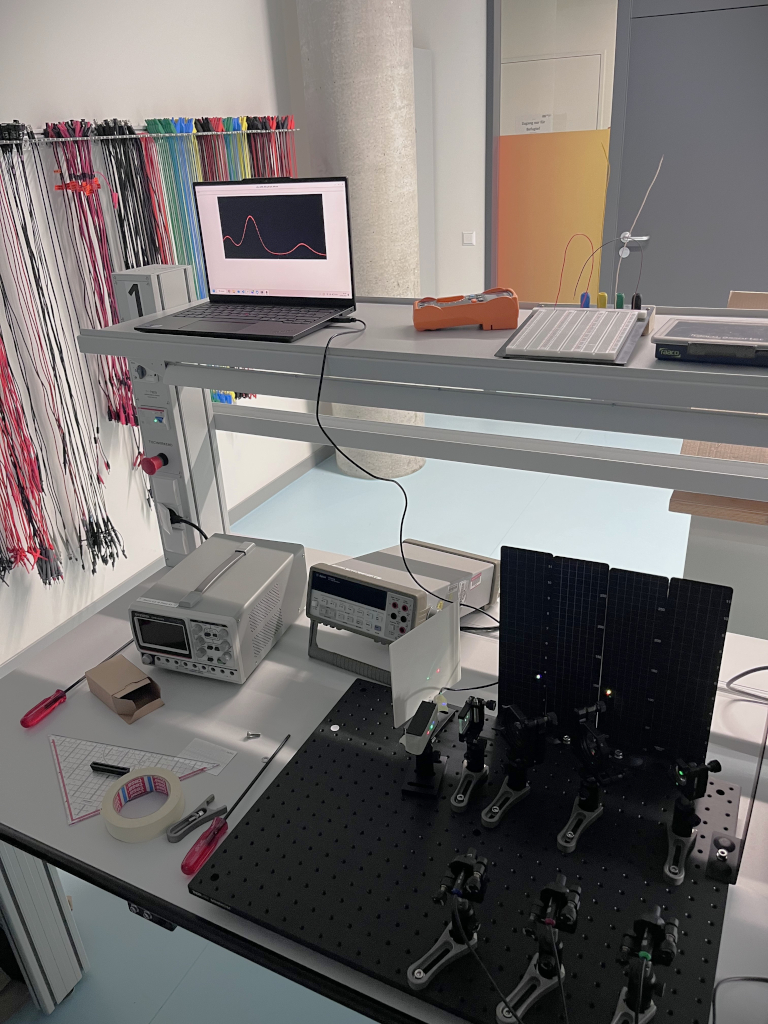
The diffraction grating spatially separates the transmitted wavelengths. The line-scan camera captures the resulting intensity distribution. (© DHBW QuantumLab)
A line-scan camera is particularly well suited to this task. It has many pixels arranged along a line and can capture the intensity distribution along this line simultaneously. This means that the spectral information is translated directly into a spatially resolved electrical signal.
In simplified form, the measurement principle can be described as follows:
This makes it very clear how an optical signal becomes a digital signal. For teaching purposes, this transition is particularly valuable: students can experience the physical effect of the grating, the function of the sensor and the digital evaluation process as part of one coherent experiment.
In this experiment, the EDU line-scan camera board forms the interface between the optical, electrical and digital domains. It is therefore not just a detector, but a central element in the signal-processing chain.
Unlike a closed spectrometer or a fully integrated measurement system, the setup remains transparent. Students can see where the light reaches the sensor, how different wavelengths are spatially separated and how a digital profile is generated from this. If a wavelength shifts or its intensity changes, this becomes directly visible in the measurement curve.
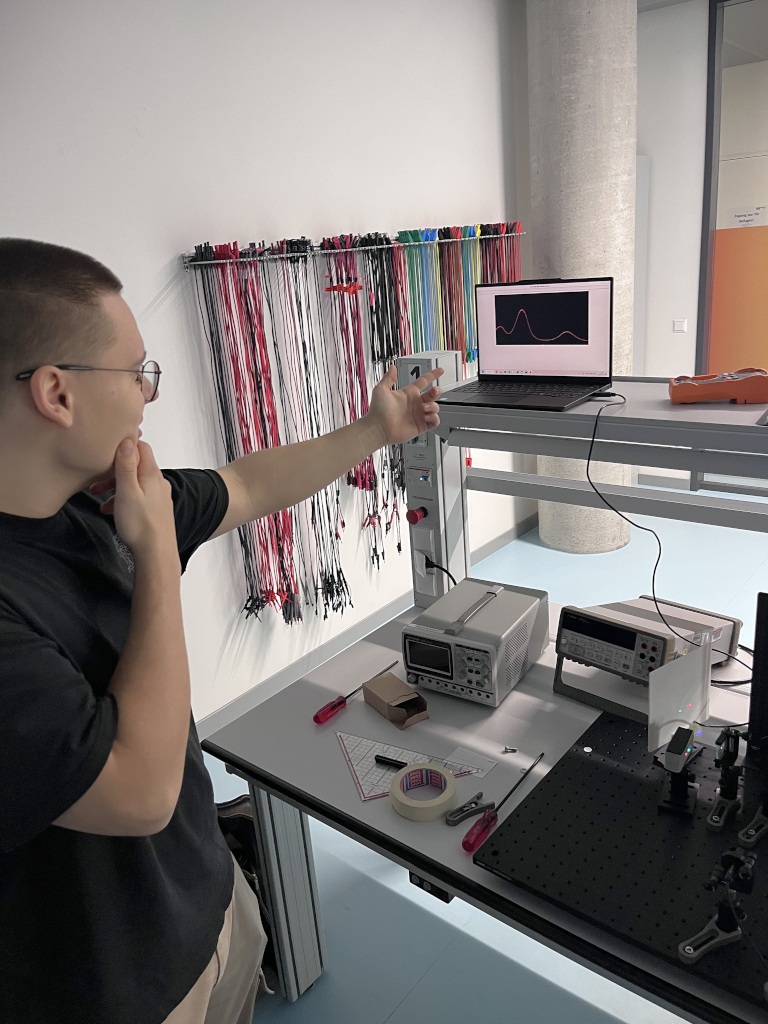
The evaluation makes the individual spectral channels visible as an intensity distribution — turning the optical domain into a digital measurement signal. (© DHBW QuantumLab)
This transparency is especially important in teaching laboratories. The EDU version of the line-scan camera was developed to be easily integrated into practical lab courses, demonstration setups and student projects. It provides a practice-oriented introduction to optical measurement technology without hiding the actual measurement process inside a black box.
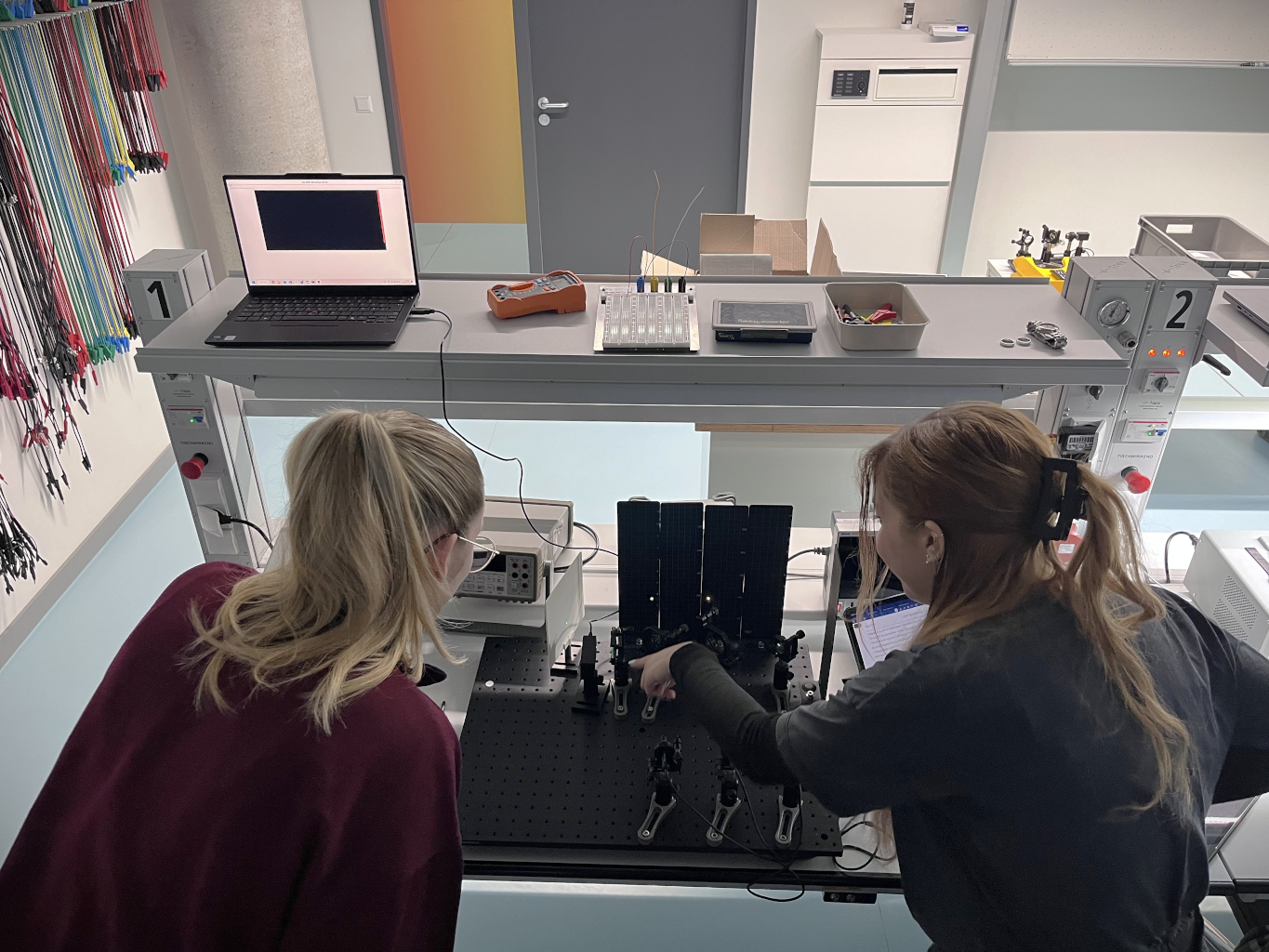
Teaching laboratory in action: students can follow the complete signal path from the optical setup to digital evaluation. (© DHBW QuantumLab)
The accompanying poster from DHBW Stuttgart places the experiment shown here within the broader context of the QuantumLab and provides a concise overview of the lab's other experiments and areas of research.
The use of EDU line-scan camera boards in the QuantumLab at DHBW Stuttgart is a very good example of what this product line was developed for: practice-oriented teaching, clear and understandable optical experiments, and the direct transition from physical effects to digital measurement data.
In the wavelength-division multiplexing experiment, the line-scan camera plays a key role. It makes spectral demultiplexing visible, measurable and evaluable. At the same time, the setup remains open enough for students to understand the underlying principles and develop them further.
This makes the experiment a successful example of modern technical education: hands-on, interdisciplinary and closely connected to real-world applications in photonics, optical measurement technology and quantum technology.
The wavelength multiplexing feature in QuantumLab impressively demonstrates how multiple optical signals can be transmitted together and then spectrally separated again. Fiber splitters provide a particularly easy way to get started with your own experiments: In our application example, we show how light sources can be combined using affordable Toslink components, split, and fed together into one of our DIY spectrometers. This makes multiplexing accessible using simple means—ideal for lab sessions, teaching labs, and student projects.
Are you planning an internship, a lab course, or a student project involving optical measurement technology? Our EDU line-scan camera boards can be easily integrated into your own setups—from simple spectrometer experiments to photonic lab exercises.
Here you can easily ask a question or inquiry about our products:
Last update: 2026-06-11

EURECA Messtechnik GmbH
Deutz-Kalker Straße 35, D-50679 Köln

 Phone: +49 (0)221 952629-0
Fax: +49 (0)221 952629-9
info(at)eureca.de
www.eureca.de