MENU
MENU
Linear variable edge filters are interference filters in which the edge (cut-on/cut-off) is not fixed but moves continuously along a filter axis. You select the desired edge wavelength by positioning the filter laterally in the beam (e. g., using a linear rail/scale). This means that a single filter can replace a whole series of fixed longpass or shortpass filters in many setups.
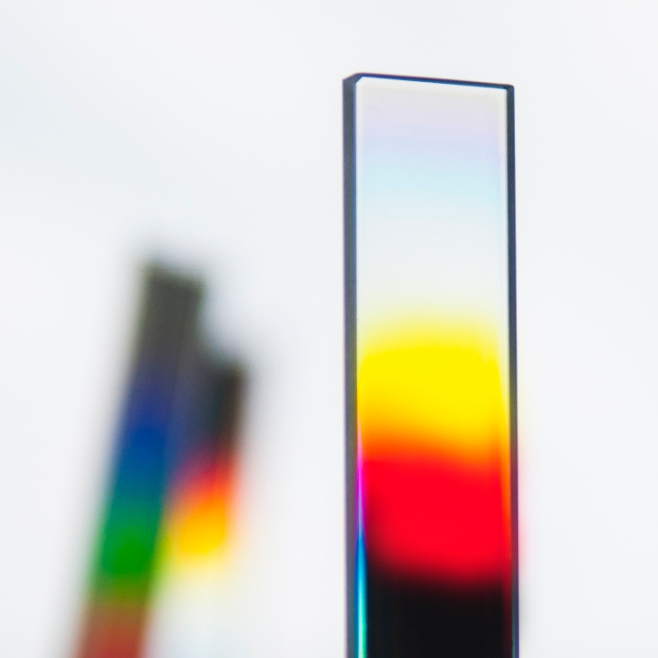
Source: Delta Optical Thin Film
Practical note: The term »linear« is historical: the position-to-wavelength characteristic curve is often monotonic, but not perfectly linear (often slightly S-shaped) and, depending on the design, can also be deliberately nonlinear.
The following information is crucial for a quick and accurate selection:
The following variants are typical, »easy-to-use« entry-level types from our partner Delta Optical Thin Film. Other areas/geometries are possible.
| λ 50 % min – max [nm] |
Product nr. | Corr. CV LWP |
Max. size [mm] |
Data sheet |
|---|---|---|---|---|
| 320 – 850 | LF102474 | LF102475 | 60 × 15 × 3 | externally |
| 386 – 1005 | LF104555 | LF104550 | 110 × 17 × 2 | externally |
| 395 – 815 | LF104557 | LF104558 | 88 × 11 × 2 | externally |
| 410 – 652.5 | LF104561 | LF104559 | 82.4 × 26.5 × 0.9 | externally |
| 652.5 – 895 | LF104562 | LF104560 | 82.4 × 26.5 × 0.9 | externally |
| λ 50 % min – max [nm] |
Product nr. | Corr. CV LWP |
Max. size [mm] |
Data sheet |
|---|---|---|---|---|
| 310 – 850 | LF102475 | LF102474 | 60 × 15 × 3 | externally |
| 365 – 785 | LF104558 | LF104557 | 88 × 11 × 2 | externally |
| 383 – 1000 | LF104550 | LF104555 | 110 × 17 × 2 | externally |
| 410 – 652.5 | LF104559 | LF104561 | 82.4 × 26.5 × 0.9 | externally |
| 652.5 – 895 | LF104560 | LF104562 | 82.4 × 26.5 × 0.9 | externally |
Details and specific information on the individual variants (including the data sheets linked in the tables above) can be found on this manufacturer's website.
Send us your key data (wavelength range, AOI, beam diameter, desired OD blocking, dimensions). Our team of experts will be happy to help you find the optimal configuration for your specific application.
Here you can easily ask a question or inquiry about our products:
Last update: 2026-02-25

EURECA Messtechnik GmbH
Deutz-Kalker Straße 35, D-50679 Köln

 Phone: +49 (0)221 952629-0
Fax: +49 (0)221 952629-9
info(at)eureca.de
www.eureca.de