MENU
MENU
A continuously variable filter (CVF)—also known as a linearly variable filter—is a wedge-shaped interference filter whose spectral properties vary continuously along one dimension. You determine the desired wavelength by shifting the filter (and, depending on the optics, also rotating it) instead of replacing the filter. Delta Optical Thin Film is a specialist in this field.

In many devices, a single CVF can replace multiple fixed filters or even a grating-based monochromator—with compact, robust mechanics.
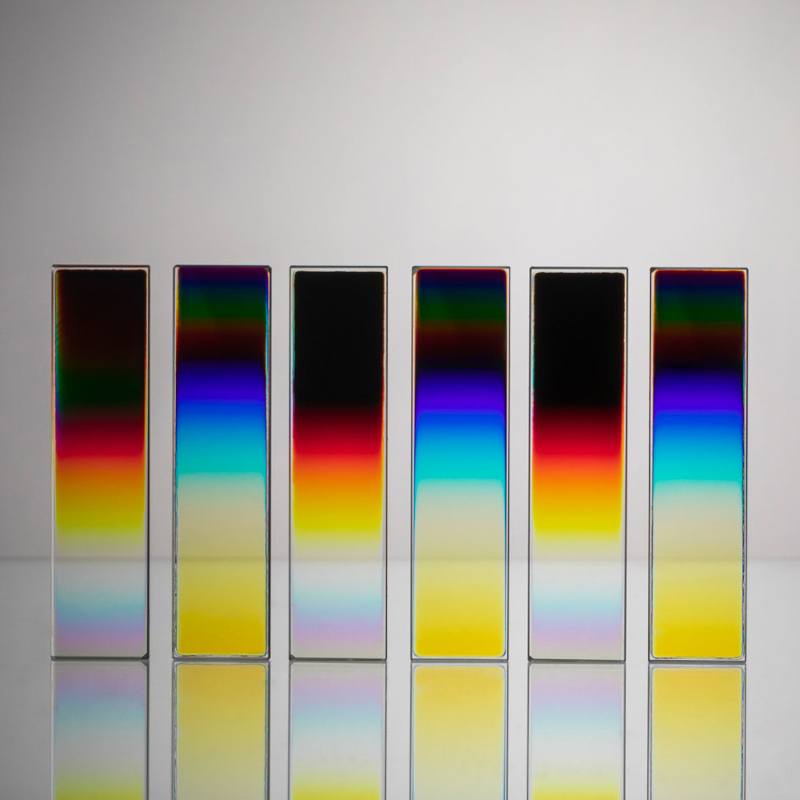
Source: Delta Optical Thin Film
A bandpass whose center wavelength shifts along the filter. Ideal when a more defined transmission window is required (e. g. 400 – 700 nm in several versions).
Variable longpass/shortpass edges; particularly universal because LWP + SWP can be used to build a tunable bandpass window. More information here.
Dichroics, mostly designed for AOI ≠ 0° (typically 45°). There are variants with nearly linear or exponential edge variation (LV/EV dichroics).
Combinations of CVLWP + CVSWP (tunable bandpass) and optional variable dichroic; sample sets show defined tuning ranges and out-of-band blocking levels (OD specifications).
Specially designed to suppress higher orders in spectrometers with diffraction gratings – with a continuously running cut-on edge, resulting in fewer »undefined« spectral ranges.
Not necessarily. The characteristic curve »position ➙ wavelength« is typically monotonic, but can be S-shaped; in addition, lines of equal wavelength can be slightly curved across the filter surface (»ring segments«), which is taken into account in beam guidance.
Send us your key data (spectral range, AOI, beam diameter/spot, desired blocking (OD), design) and our team of experts will recommend the right CVF subtype and a specific variant for you.
Here you can easily ask a question or inquiry about our products:
Last update: 2026-01-14

EURECA Messtechnik GmbH
Deutz-Kalker Straße 35, D-50679 Köln

 Phone: +49 (0)221 952629-0
Fax: +49 (0)221 952629-9
info(at)eureca.de
www.eureca.de