MENU
MENU
Interference-based bandpass filters are optical filters whose spectral properties are created by multiple thin layers with carefully tuned refractive indices and layer thicknesses. Through interference, certain wavelength ranges are preferentially transmitted, while others are suppressed.
Bandpass filters only allow a defined spectral range around a central wavelength to pass through. They are used, among other things, in spectroscopy, fluorescence measurement technology, optical sensing, imaging, lighting and laser technology, as well as in numerous research and development setups.
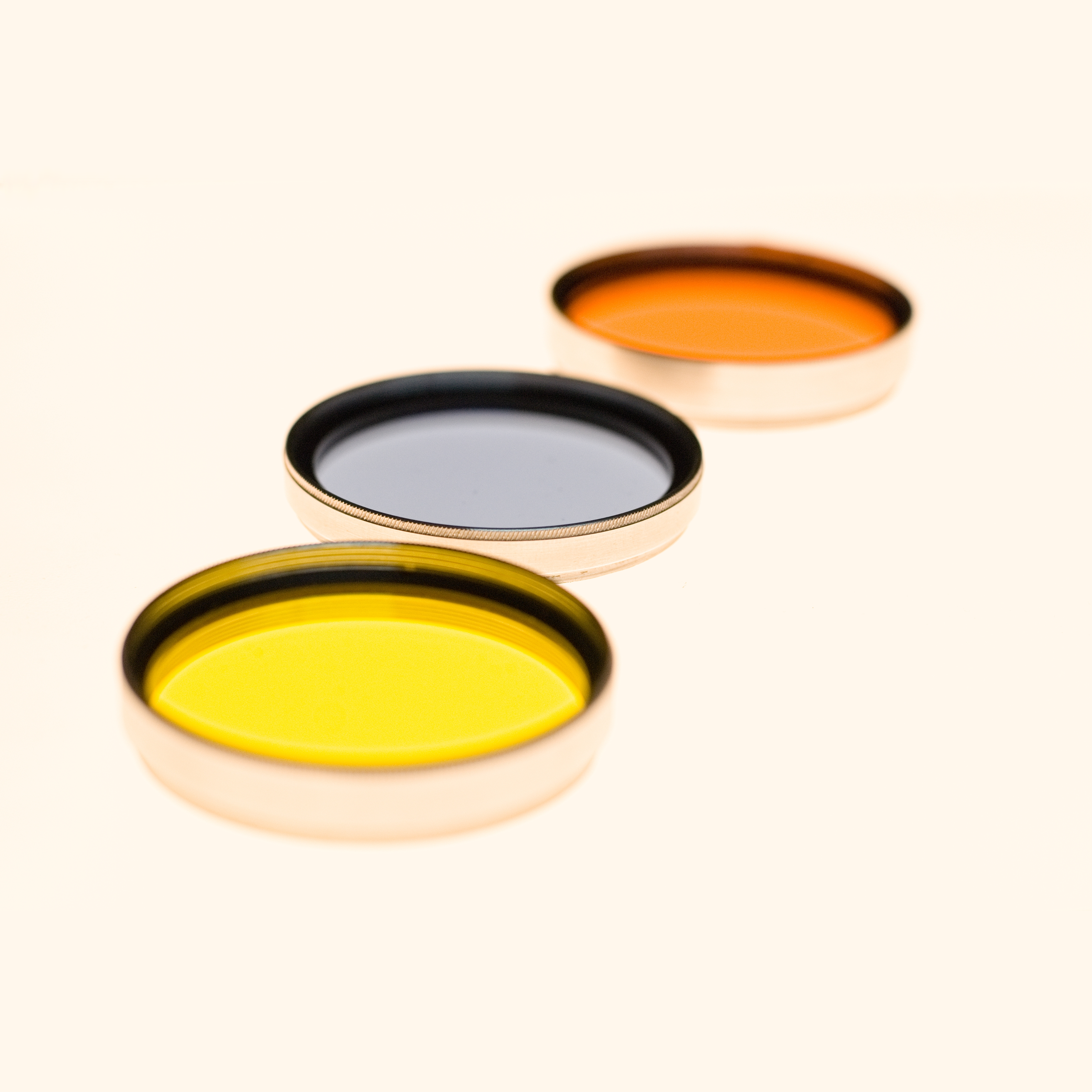
Many filter families are available in multiple mechanical sizes. In the UV, VIS, and NIR ranges, this includes—depending on the specific filter—round versions with diameters of approximately 13 mm, 25 mm, or 50 mm, as well as 50 × 50 mm square filters.
Different standard dimensions and variants may apply to filters designed for the extended infrared range. Therefore, the specific versions available are listed separately for each filter family.
While size does not fundamentally affect the filter's spectral performance, it is crucial for integration into the existing optical setup. Compact sensor and measurement systems often require only a small clear aperture, whereas larger beam cross-sections or imaging applications necessitate correspondingly larger filters.
You can access the specific detail page for a filter family by clicking on the linked filter names or sizes.
There, you will find—where available—additional information such as:
Since multiple mechanical versions can belong to the same optical filter family, they are grouped together on a single detail page.
Last update: 2026-09-21

EURECA Messtechnik GmbH
Deutz-Kalker Straße 35, D-50679 Köln

 Phone: +49 (0)221 952629-0
Fax: +49 (0)221 952629-9
info(at)eureca.de
www.eureca.de