MENU
MENU
For years, Eureca's research and development projects have been guided by a shared vision: scientific measurement technology should not only function, but also be transparent, modular, and adaptable. Step by step, this approach has given rise to a technical development path: from line scan cameras and photodiode amplifiers, through single-photon detection and time-correlated measurements, to integrated experimental systems for quantum technology.
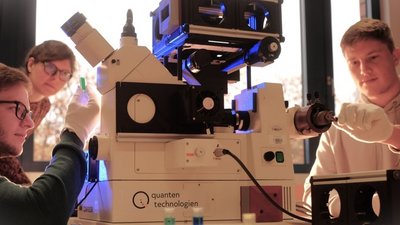
The common thread: The BMBF research project OptoCubes, completed in 2023, laid the technological foundation for modular optical measurement systems. The follow-up project, quantumexpedition , applies this approach to the field of quantum sensing and single-photon detection. And the brand-new BMFTR collaborative project »Gemischt interaktive FLEXIKA« (»Mixed-Mode Interactive FLEXIKA«) brings both lines of research together: robust, open quantum systems suitable for research and teaching, whose structure and measurement principles remain visible and understandable.
OptoCubes ➙ quantumexpedition ➙ FLEXIKA
Eureca Messtechnik has been working for many years at the intersection of optoelectronic components, scientific measurement technology, and practical applications. Publicly funded research projects give us the opportunity to test new technologies early on in collaboration with universities and to use them to develop systems that can later be applied in research, teaching, and industrial development.
Our goal is not to develop a “black box” that is as closed off as possible. On the contrary: particularly in research and teaching, it is often crucial that the individual functional blocks of a measurement system remain identifiable. The sensor, analog electronics, data acquisition, software, and optical setup should be transparent, interchangeable, and adaptable to new research questions.
This philosophy unites hardware development across the three projects: OptoCubes, quantumexpedition, and FLEXIKA. Each project builds on the technical and educational experience of the previous one—and expands the scope of measurement a step further toward modern quantum technologies.
The BMBF project OptoCubes (»Open-Source Modular System for Agile Prototyping of Laser-Based Sensors«, February 1, 2020, through October 31, 2023) laid the foundation for many of Eureca's current developments. In collaboration with the University of Osnabrück and the South Westphalia University of Applied Sciences, a modular system was developed that allows optical and laser-based sensors to be quickly assembled from individual, traceable functional modules.
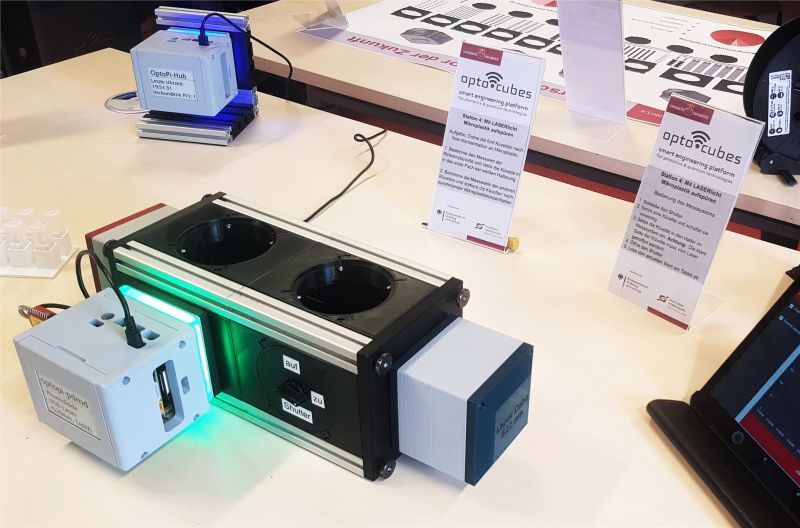
OptoCubes was particularly important to Eureca because this project involved the development and refinement of key detector and readout components that could later be used as building blocks for more sophisticated measurement systems.
An important result of this development is compact line-scan camera modules, including those based on Toshiba's TCD1304DG line sensor. Rather than a closed camera system, the focus is on the actual measurement function: a linear image sensor, a well-defined sensor drive/timing, digital data acquisition, and integration into custom setups that is as simple as possible. Today, these modules form the basis for our spectrometer developments and for customer-specific OEM solutions, among other applications.
This approach is ideal for spectroscopy in particular. A line sensor directly captures the spectrum as a spatial distribution; the electronics handle clocking, readout, and digitization. This makes the measurement chain transparent and allows the sensor, optics, slit, grating, and software to be optimized separately.
At the same time, high-performance photodiode amplifiers were developed within the OptoCubes ecosystem. These amplifiers convert the very small currents from a photodiode into digitally evaluable measurement quantities, covering a range of measurement principles—from classic transimpedance amplifiers to integrating measurement techniques for particularly low signal levels.
This provided a second fundamental building block: In addition to spatially resolved sensors, it was now possible to detect individual optical channels with high sensitivity and well-defined gain. This combination of detector, analog signal processing, and digital readout was later significantly expanded for use in quantum sensing.
OptoCubes did not merely create individual devices. The project established a modular development approach at Eureca: the detector, front end, data acquisition, and software are conceived as combinable functional blocks.
With quantumexpedition (»An Open Innovation Platform for Quantum Sensing Using the Life Sciences as an Example«, January 1, 2024, through December 31, 2026), the open, modular system concept developed in OptoCubes is being applied to quantum technology. In collaboration with the University of Osnabrück, the goal is to make quantum sensor technology practically accessible and to create experimental systems that can be understood and operated not only by specialized laboratories.
From a technical standpoint, this step represents a fundamental shift: While line scan cameras and photodiodes measure continuous or integrated light signals, a quantum system must be able to detect individual photons as discrete events. This makes the measurement chain more time-sensitive—and at the same time, it opens the door to entirely new experiments.
As part of this development, APD-based single-photon detectors have taken center stage. An avalanche photodiode can be operated in such a way that even a single incoming photon triggers a clearly detectable electrical event. An analog light signal is thus converted into a sequence of individual count pulses.
This places new demands on electronics and software: dark count rate, detection efficiency, dead time, time resolution, and statistical fluctuations become key parameters. At the same time, the familiar modular architecture of OptoCubes can still be used: the detector, signal conditioning, digital acquisition, and analysis software remain clearly separate functional blocks—only the time scales and signal levels change drastically.
The next logical step is coincidence detection. Here, it is no longer enough to simply count photons. What matters is whether two detectors register events nearly simultaneously within a very small time window. It is this temporal correlation that makes many quantum optics experiments possible.
To this end, the detection chain is expanded to include two-channel analysis, fast timing logic (or time-tagging functions), and digital coincidence counting. The measurement thus provides not only singles count rates but also coincidence rates, time windows, and statistical parameters such as the ratio of the useful signal to the random background.
Classical optical metrology is thus gradually evolving into a platform for single-photon and correlation measurements. It is precisely this experience that serves as a crucial technical bridge to the subsequent FLEXIKA project.
OptoCubes made light measurable. quantumexpedition makes individual photons and their temporal relationships measurable.
The collaborative project »Mixed-Mode Interactive FLEXIKA: Quantum Technology to Engage Interdisciplinary STEM Students in Biology, Chemistry, Computer Science, and Electrical Engineering« consistently builds on previous developments. While previous projects focused on developing core detector, electronics, and software components, the current emphasis is more strongly on integrating these into complete, robust experimental systems. The systems are designed to enable scientifically meaningful measurements while remaining open and transparent enough to be used in research, university teaching, and hands-on learning formats.

For Eureca, one particular development is at the center of this effort: a compact, robust, and enclosed coincidence test bench for microstructured photonic structures, supplemented by digital supporting materials and new transfer and outreach formats. Such structures can serve as sources of correlated or quantum-optically usable light states. To quantitatively investigate their properties, a stable detection chain is required that not only counts individual photons but also reliably records their temporal correlation.
This is where the experience gained from both previous projects comes together. OptoCubes has contributed the modular approach, experience with sensitive detectors, analog electronics, data acquisition, and USB connectivity. quantumexpedition has added single-photon detection, fast timing functions, and coincidence logic.
The FLEXIKA test bench will integrate these components into a complete measurement system. These include the optical setup and reproducible sample positioning, as well as a two-channel photon-sensitive detector module, analog front ends, amplification and signal conditioning, coincidence logic with a defined timing window, digital or USB-based data acquisition, and operating and analysis software.
The goal is not merely to demonstrate that a photonic component functions in principle. The test bench is designed to provide quantitative quality metrics—such as singles rates, dark counts, coincidence rates, signal-to-background ratios, and other parameters relevant to characterization. In turn, these measurement results can be fed back into the manufacturing and optimization of the microstructured components.
FLEXIKA is deliberately not designed exclusively as a technological development for specialized research laboratories. A significant part of the project focuses on translating the developed systems into educational and outreach formats. Digital supplementary materials are intended to explain the fundamentals of physics, system setup, measurement procedures, and data analysis in an accessible way. In addition, interactive and VR-based formats are planned to illustrate how the systems work even in situations where a complete laboratory setup is not available.
The systems will be tested with students and users and further improved based on their feedback. This creates a cycle of research, technical development, practical application, and pedagogical feedback.
OptoCubes – open detector modules and transparent measurement chains: line scan camera, photodiode amplifier, data acquisition, and software.
quantumexpedition – Expansion into the single-photon range: APD-based detectors, photon counting, time-resolved detection, and coincidence measurement.
FLEXIKA – Integration into comprehensive quantum systems: enclosed coincidence test bench, characterization of microstructured thin-film lithium niobate components, laser-scanning quantum microscope, and digital and immersive knowledge-transfer formats.
Line scan camera ➙ Photodiode Measurement ➙ Single-photon detector ➙ Coincidence detector ➙ Integrated FLEXIKA experimental systems
For Eureca, OptoCubes, quantumexpedition, and FLEXIKA are therefore not separate research silos. The projects form a coherent line of development. With each step, the measurable signals become smaller, the temporal requirements more demanding, and the physical questions more complex. At the same time, the basic principle remains the same: the measurement technology should be modular, understandable, and adaptable.
An open line scan camera evolved into a platform for spectral measurements. Expertise in detecting the faintest optical signals grew out of sensitive photodiode electronics. With single-photon detectors and coincidence electronics, it became a tool for quantum experiments. FLEXIKA now combines these building blocks into complete systems that characterize new photonic components and make quantum-sensing measurement methods practically accessible. In this way, several research projects are growing into a shared technology platform—and individual components are evolving into tools for the next generation of optical and quantum technology experiments.
The experience gained in the research projects has an impact far beyond the duration of each project. Electronics, detector modules, software concepts, and mechanical solutions are incorporated into new Eureca products, custom developments, and educational systems. At the same time, practical applications give rise to new research questions.
This is precisely where we see the value of publicly funded collaborative research: Universities contribute current research questions and methods, while companies translate them into robust and reproducible technology—and together, they create systems that can advance research and teaching in the long term.
Here you can easily ask a question or inquiry about our products:
Last update: 2026-09-29

EURECA Messtechnik GmbH
Deutz-Kalker Straße 35, D-50679 Köln

 Phone: +49 (0)221 952629-0
Fax: +49 (0)221 952629-9
info(at)eureca.de
www.eureca.de