MENU
MENU
Precise control of temperature and humidity is not merely a »nice-to-have« in many technical and biological processes, but a fundamental prerequisite for reproducibility. Particularly in the food industry—such as in cheese production, fermentation, tobacco processing, or the drying of herbs—this consistency is crucial to the final result.
However, simple two-point controls (on/off) often fail due to system dynamics, because:
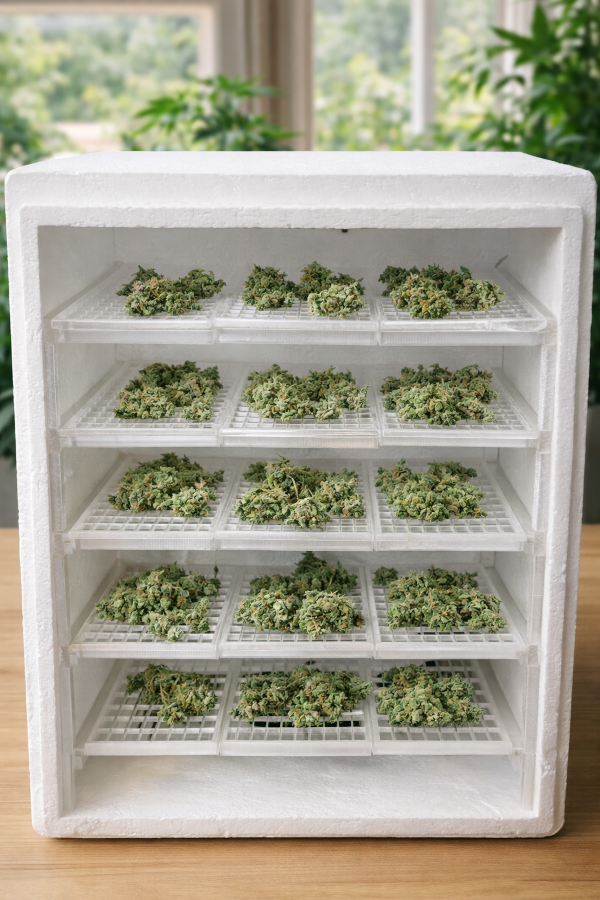
A view inside the drying box containing dried plant material (AI-assisted image)
Drying plants is one of the oldest and most important processing methods. It involves far more than simply removing water: the key is to control quality, aroma, and shelf life in such a way that the product remains stable and active ingredients and aromas are preserved as much as possible.
The central challenge lies in achieving the right physical balance:
In sensitive areas, precision control is therefore the decisive factor:
The goal: to achieve optimal storage stability without degrading the material due to thermal stress or excessive air velocities.
Technical precision is particularly critical when drying cannabis flowers, as the valuable compounds (cannabinoids and terpenes) are found in the trichomes. These tiny, resin-filled glandular heads are extremely sensitive to physical and thermal stress.
Success is determined not by the relative humidity of the environment, but by the water activity (aw value) within the flower. The aw value describes the water available for chemical and biological processes.
When the aw > 0.70, the likelihood of mold spores such as Botrytis cinerea (gray mold) germinating increases dramatically. Safe storage stability is only achieved at values between approximately 0.55 and 0.62.
At the same time, we aim for a water content (WC) of 10 – 12 %. This range has proven to be the »sweet spot« not only for cannabis but also for high-quality medicinal herbs, tobacco, and tea, ensuring the right texture and preserving the essential oils. It prevents the material from crumbling while ensuring clean further processing.
If the temperature drops below the dew point in certain areas (e. g., on the surface of a flower), water activity rises immediately—creating an ideal breeding ground for microorganisms, even if the average values in the room appear to be within normal range.
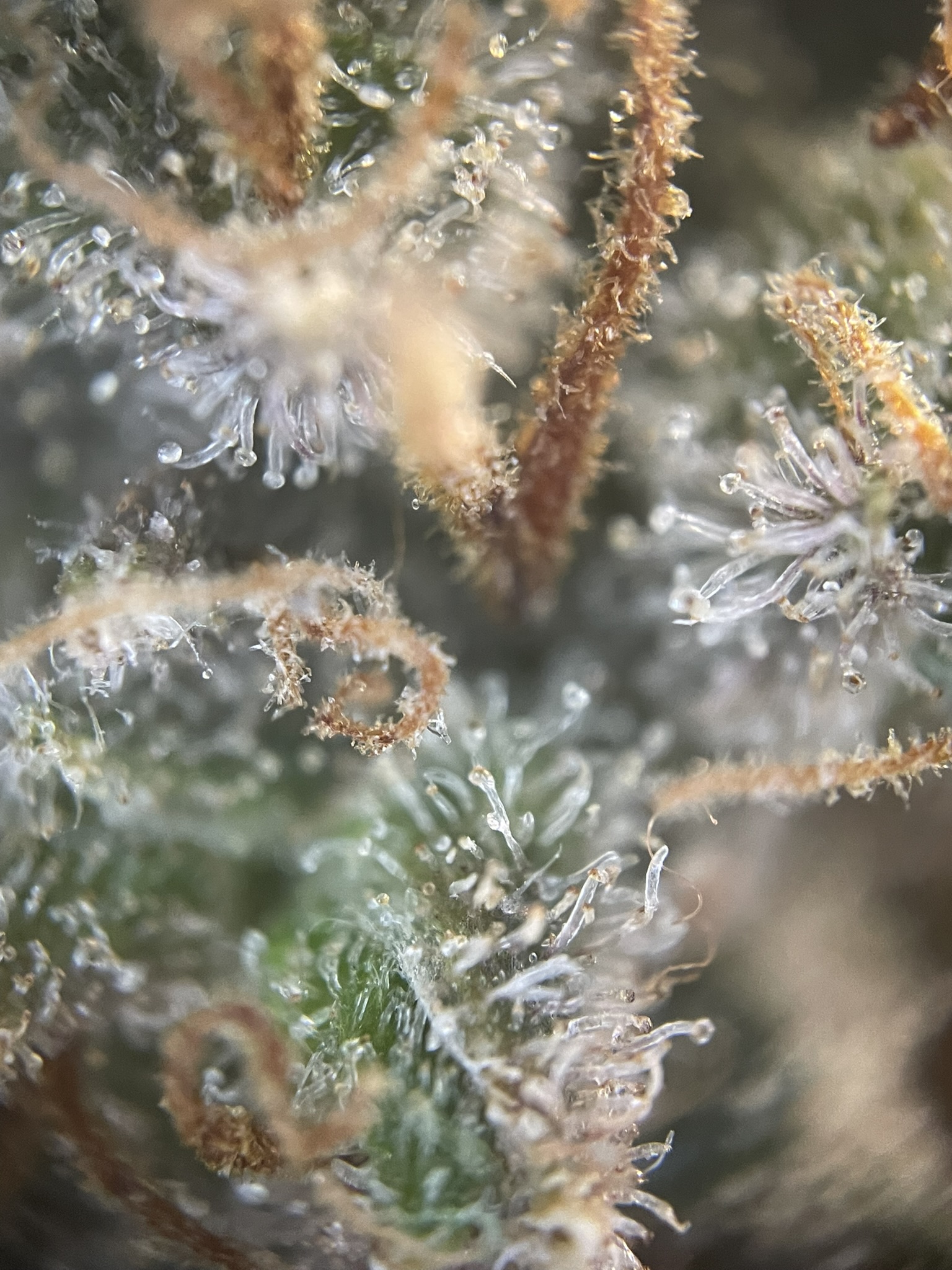
Trichomes (hair-like growths on plant surfaces)
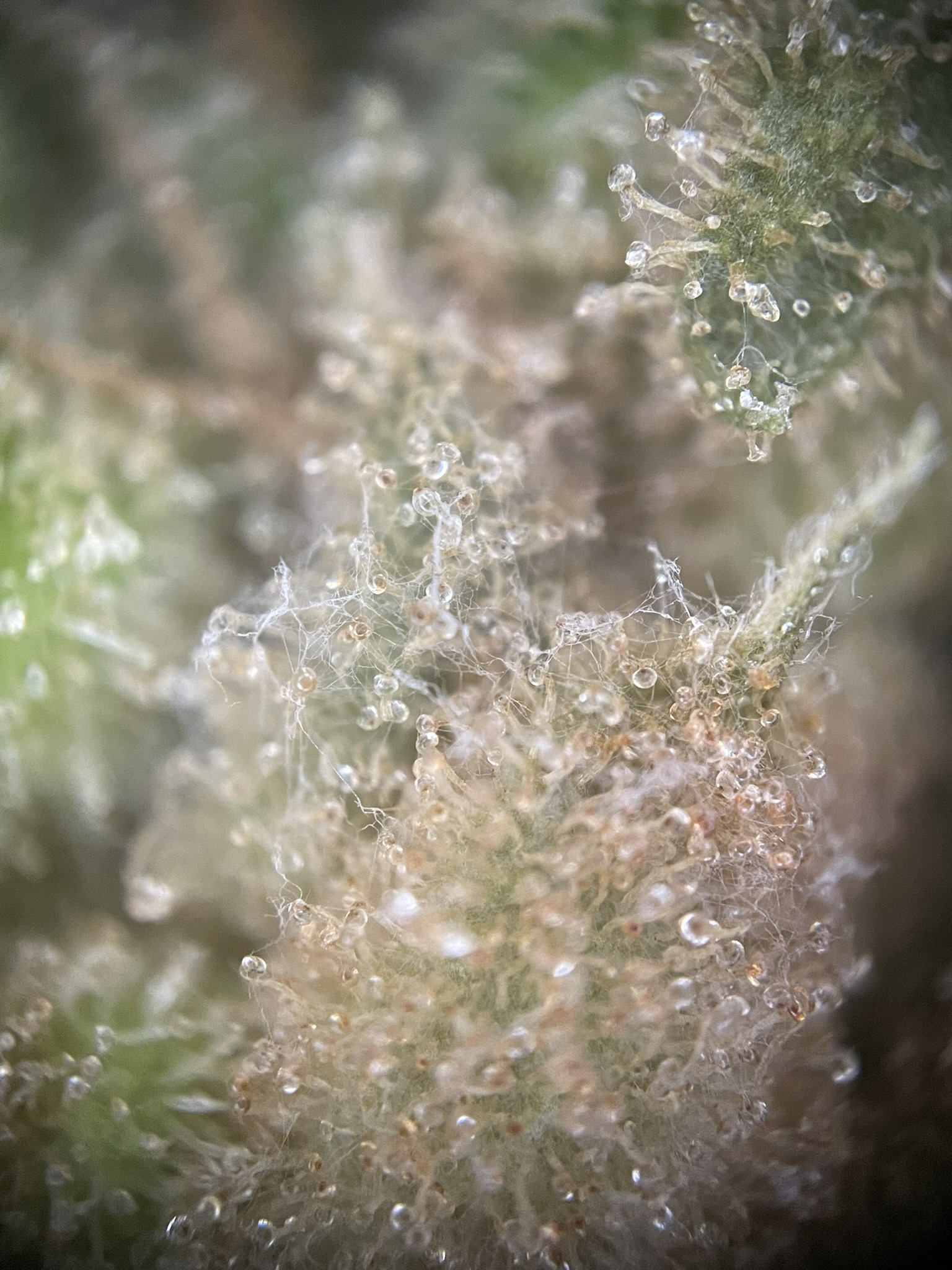
Trichomes with mold
The microscope images clearly show that mold is not a coincidence, but rather the result of inconsistent environmental conditions. Only a control system that actively monitors and regulates the dew point can preserve the trichomes while simultaneously eliminating the risk of mold.
During the drying process, plant material loses moisture by releasing water vapor into the surrounding environment. Physically, the rate at which this occurs depends on temperature and relative humidity. Instead of controlling both factors separately, professional drying uses the Vapor Pressure Deficit (VPD)—the difference between the maximum possible water vapor pressure and the actual water vapor pressure in the air.
Although the VPD no longer has an active biological function after harvest (such as controlling the stomata of living plants), it is the decisive indicator of how strongly the evaporative force of the environment affects the plant material.
Consistent evaporation is particularly important when drying cannabis, as the valuable compounds (cannabinoids and terpenes) are found in the trichomes. Terpenes are volatile, aromatic molecules that not only determine the scent but also have pharmacological effects (e. g., anti-inflammatory or calming). They are extremely sensitive to heat, oxygen, and mechanical deformation.
During drying, the plant tissue shrinks and the trichomes also lose water. Controlling the VPD is the critical tool here:
In summary, VPD-controlled drying means:
Whether medicinal plants, cannabis, or tobacco—precise VPD control is the fundamental prerequisite for a final product of the highest quality, whose active ingredient profile and physical properties have been optimally preserved.
To preserve the physical properties and sensitive active ingredient profile described throughout the entire drying process, modern process engineering relies on the principle of condensation drying in a closed air circuit.
In industrial pharmaceutical and food production, this is the gold standard, as it completely eliminates dependence on fluctuating external conditions (temperature/humidity).
The main problem with conventional dryers is the rigid coupling of temperature and humidity. An industrial system breaks this relationship through a three-phase, external air treatment process:
Because the system is completely isolated from the outside air, changing environmental conditions have no effect on the internal microclimate. This ensures consistent reproducibility of the drying parameters, regardless of atmospheric fluctuations at the installation site.
Since no outside air is drawn in, no new mold spores, dust, or contaminants come into contact with the sensitive material being dried.
Thanks to constant circulation and recirculation, there is no »stagnant moisture« or local cold bridges.
The challenge was to scale down the industrial principle of external air treatment in a way that makes it practical and affordable for research laboratories, pharmacies, or small manufacturing facilities. To achieve this, we rely on a hybrid approach combining industrial core components with smart infrastructure.
To cool the system efficiently and quietly, we use proven high-performance components from the PC sector: A PC water-cooling system dissipates waste heat to the outside, while high-quality ball-bearing fans and a standard PC power supply ensure stable airflow and a reliable power supply.
To make efficient use of the technical components, the enclosure design follows the principle of strict zone separation. A highly insulated polystyrene box serves as a protective shell, minimizing external thermal disturbances and thereby increasing control precision inside. The center of the box is the product chamber: Here, the material rests on special mesh layers, which protect it from direct thermal influences from the actuators. Separated from this by a physical barrier, a vertical climate shaft is located in the rear section. The actual air conditioning takes place in this channel before the conditioned air is directed back to the material in a controlled manner.
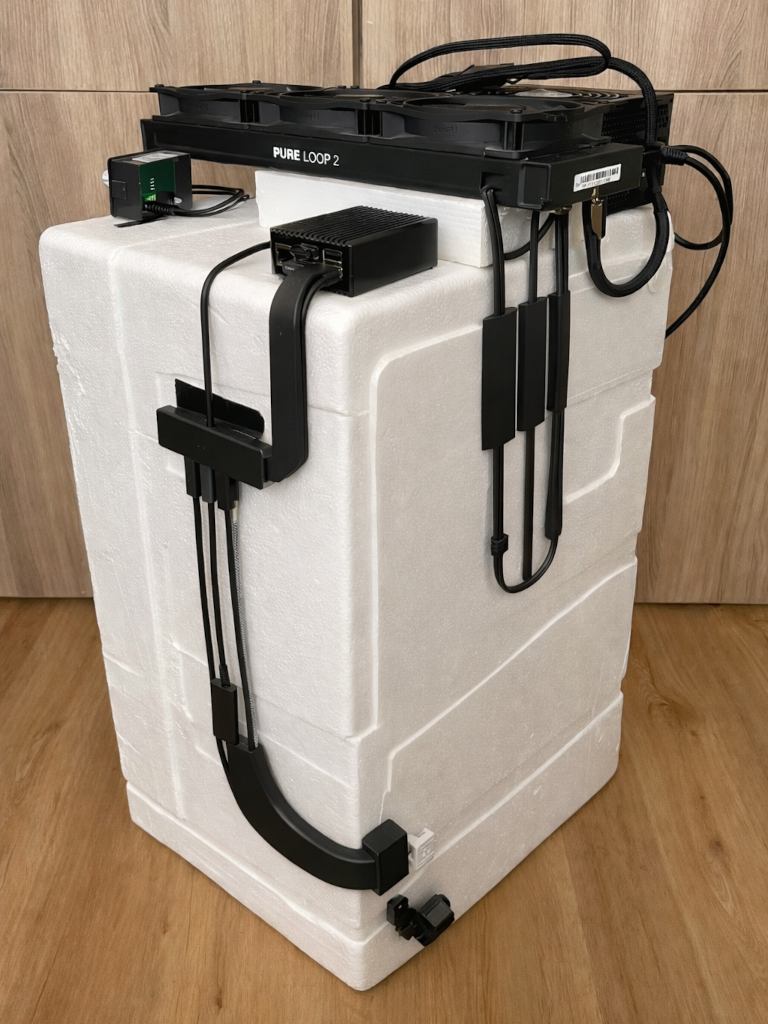
Illustrative image of a styrofoam-based drying box with external components (AI-assisted visualization)
The airflow simulates external climate control in three steps:
The result: This combination of mechanical isolation and precise PID control results in an extremely stable VPD window.
The unit employs a hierarchical cascade control system in which the vapor pressure deficit (VPD) serves as the master setpoint. This controls all subordinate variables to physically prevent drift into the »mold zone« or irreversible overdrying.
The Raspberry Pi continuously calculates the dew point. based on the current humidity. This is the temperature at which water vapor condenses into liquid water—the key factor in moisture removal.
The Peltier element is controlled so that the heat sink temperature (TKK) drops exactly below the dew point. The difference (ΔT) between the air dew point and TKK directly determines the dehumidification rate.
The air velocity defines the heat transfer at the heat sink and regulates the thermal coupling between the Peltier element and the airflow. In the product chamber, this control mechanism creates a steady, gentle circulation that breaks up the saturated boundary layer on the biomass. This ensures that the VPD gradient is not only detected by the sensor but also penetrates deep into the tissue of the flowers without subjecting the material to mechanical stress.
A key feature of the box is its carefully engineered hardware design: the counter-heater is mounted on a solid aluminum heat sink.
This thermal capacity acts as a physical filter. It smooths out high-frequency fluctuations in the PID control and ensures extremely smooth temperature control—evident in the nearly linear measurement curves of the sensors.
Since dehumidification at the Peltier inevitably extracts energy from the air, the counter-heating precisely counteracts this. Through this »Cool-Dry-Reheat« process, temperature and relative humidity (and thus the VPD) remain completely decoupled and controllable.
Based on experience, a timeframe of 7 to 10 days represents the optimal compromise for the duration of the drying process. Within this range, the ideal VPD range is between 1.0 kPa (start) and 0.8 kPa (end).
Anything that dries faster often results in a flat aroma and a brittle structure.
Anything that takes significantly longer keeps the moist core at a dangerously high water activity (aw) for too long, which unnecessarily increases the risk of mold.
A stable VPD ensures that moisture migrates from the interior as quickly as the surface releases it. This prevents the dreaded »case hardening« (external glazing with internal moisture).
As soon as the material stops releasing water into the air, the required dehumidification capacity of the Peltier module drops to near zero. This is the physical signal: the target equilibrium has been reached. The plant material can then remain in the box without overdrying, as the humidity is maintained precisely at the target value.
A key feature of the box is its preparation for individual long-term storage. Since every user has different conditions (e. g., a cool basement vs. a warm living room), the box allows for precise »target matching«
Here you can easily ask a question or inquiry about our products:
Last update: 2026-04-27

EURECA Messtechnik GmbH
Deutz-Kalker Straße 35, D-50679 Köln

 Phone: +49 (0)221 952629-0
Fax: +49 (0)221 952629-9
info(at)eureca.de
www.eureca.de